An interlude, between chapters nine and ten
On Koko and Knoppix.
In which the author sets the equations down for a moment, and tells you the truth about two dogs.
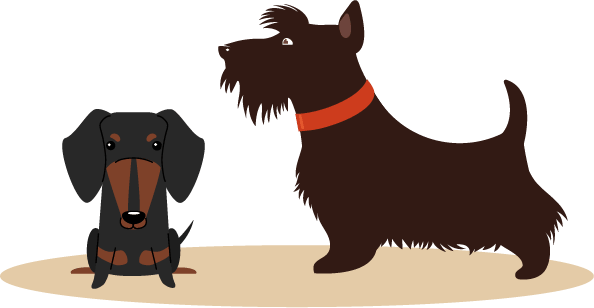
I want to step out of the argument of this book for a chapter, because there is a debt I have been carrying since Chapter 2 that the equations are not the right instrument to pay.
The debt is to two dogs. Their names were Koko and Knoppix. Koko was a smooth coat dachshund. Knoppix was a wirehaired dachshund. They were not the largest dogs anyone has ever owned. They were not the smartest dogs anyone has ever owned. They were, in the only way that mattered, mine.
I described, in Chapter 2, the family therapist's recommendation that my then wife and I get a dog, on the theory that the dog would awaken in me some dormant paternal instinct and incline me, eventually, toward the children she was beginning to want and I was refusing to consider. I described, with a certain comic relish, how this plan backfired, because the dogs were so good and I loved them so completely that all my paternal instinct was, by their arrival, immediately and permanently spoken for.
That was the joke version. The joke version is true. The joke version is also, I want to say in this chapter, only one slice of a much longer thing. The longer thing is what I would like to tell you now, in three movements, because what these two dogs did for me, over the next sixteen years, has no place in any of the mathematical chapters and it should not be made to fit one.
There will be no equations in this chapter. There will be no Python. There will be no figure. There will be just the truth about two dogs, and what they did for a man who, without them, would not be writing this book.
Movement one
What kept me alive.
I want to say something now, plainly, because the rest of the chapter does not work unless I say it first.
During the twelve days of my nervous breakdown, and during the eight months of clinical depression that followed, I considered, on more occasions than I would like to count, ending my own life. I want you to register this without dramatizing it. The thinking was not abstract. The thinking was specific. The thinking had timetables and methods and a kind of calm clarity that I now understand to be one of the warning signs of the condition I was inside. I was alone. The marriage was over. My father and my uncle were both alive, but I had not had family in any meaningful sense since the afternoon I was asked to leave home at eighteen. The ties had been severed then, cleanly, and they had not regrown. I had no family in the room.
There was, in that apartment, exactly one thing keeping me on the planet. There were two of that one thing. They were lying on the rug.
The question I could not, on any of those evenings, get past, was the question of who would take care of them. I was the person who knew the small specific things about each dog. I knew which of Koko's ears she preferred scratched. I knew that Knoppix needed his food slightly warmed in the winter or he would not eat. I knew, between them, several hundred such things, accumulated quietly over years, none of which any other human being on Earth knew, and none of which I would have any way of transferring to anyone in any amount of time.
If I left, the dogs would be handed to someone. The someone would not know any of the things I knew. The someone would, with the best intentions, fail to scratch the correct ear, fail to warm the correct food, fail to recognize the small specific signs by which each of them communicated distress. The dogs would not understand why I was gone. They would not understand why the person who came to feed them was not the person who had fed them every morning since they were puppies. They would, in their small specific way, be confused, and the confusion would be a slow form of suffering, and the suffering would be my fault for having left.
This was the chain of reasoning that, every night for eight months, kept me alive. It was not a heroic reasoning. It was not a reasoning anyone would print on a poster. It was the small persistent thought that two animals, asleep on the rug, were depending on me for things that I, and only I, knew how to give them, and that abandoning them was not a thing I was permitted to do.
People often ask, of people who have come through such a stretch, what saved them. I am, in middle age, suspicious of clean answers to that question. But I will say this. I am alive because of two dogs. The dogs did not know. The dogs were not trying to keep me alive. The dogs were lying on a rug, asleep, in the way dogs are. They saved me by being the load I could not, in good conscience, put down.
Movement two
What helped me recover.
I started to get better, slowly, in the way one starts to get better, which is to say in small ratchets, with frequent retreats, and with no clear sense, at the time, of being in a recovery. The recovery is, mostly, only visible afterwards, when you turn around and realize you have walked further than you remember.
The dogs were, in this slow walking, the only continuity. Anna and the people at LLL were doing the structural repair, which I have already described in Chapter 5 and will not repeat here. But the day to day, the small unspectacular work of being a person again, was done largely in the company of two dachshunds who did not, at any point, require me to be functional.
This is what I want to say about dogs, and what almost no book about mental health says with sufficient clarity. The dogs do not need you to be okay. The dogs need you to feed them. The dogs need you to take them out. The dogs need you to be in the room. The bar is, in the most useful possible way, low. The bar is not be the man you were before. The bar is not feel things. The bar is open the door to the garden. You can do that. You can do that even when you cannot do anything else.
The clinical literature has, I am told, a phrase for this. Behavioural activation. The idea is that doing small things, even mechanically, even without feeling them, slowly resumes the brain's capacity to feel them. It works. I have, with some embarrassment, the testimony of my own life to offer in support of it. I did not, in those months, feel the dogs the way I had before. I did not feel anything, really, the way I had before. But I opened the door. I put down the food. I walked them in the small park near the apartment. I did the things. The things, performed without any internal accompaniment, slowly grew an internal accompaniment of their own. By the end of the eight months I was, by small unmistakable signs, present again. The dogs had not done any of this. The dogs had merely required me to keep being there, every morning, in the same room, doing the same small unglamorous things. The repetition, it turns out, was the recovery.
There is a thing dogs do, particularly small old dogs, where they push their head into your hand without quite waking up. They are, in some half-conscious doggish way, checking. They are confirming that you are still the person attached to the hand. Knoppix did this, in his old age, hundreds of times. I did not, at first, register it as anything in particular. It was just a small dachshund leaning on me from his sleep. I came eventually to understand it as one of the most important pieces of information I was receiving from the world, which was the information that a small living animal had decided, against the considerable evidence of my recent behaviour, that I was still trustworthy. That information, repeated, every day, for years, did more work on my interior than most of the conversations I have ever had with people.
This is, I think, the gift of dogs to anxious humans. They do not require you to perform. They require you to be there. The being there, repeated enough, becomes the personality the depression has been telling you was permanently lost. The personality was not lost. The personality was waiting for the door of the garden to be opened, one more time, by a man who, between him and the world, had two dogs and a leash.
Movement three
What they left.
Koko died at fourteen. Knoppix died at sixteen. They both died in my arms. I do not want to write more about either moment than that, because the moments are mine and the description, on any page, would diminish them. I will say only that there is a particular weight a small dachshund acquires when she has stopped breathing, and there is a particular silence in a room afterwards, and these are things you carry for the rest of your life in the part of you that does not have words.
I had thought, in advance, that I would not survive it. I had carried for some years the specific worry that the deaths of these dogs would, given everything else, be the thing that finally undid the recovery the rest of my life had built around them. I had, in some quiet way, organized my courage in advance for this purpose. I expected the deaths to break me.
They did not break me. They came close, in both cases, but they did not break me.
What I did not expect, and what I want to record honestly here because I think it is the most important sentence in this chapter, is that the deaths made me stronger. Not because I gained anything from them. The deaths are not what people in books like to call experiences. The deaths were not opportunities for growth. The deaths were losses. The losses hurt in a way that, three years after the second of them, still hurts on certain afternoons in a way I cannot describe to anyone who has not lost an animal they loved completely.
But the man who survived the losses is a different man from the one who feared them in advance. The fear was that I would not be able to live without the dogs. The reality is that I do live without the dogs, and that the living is fuller, not emptier, because I loved them as completely as I did. The love they taught me did not depend on their continued presence to remain valid. The love had, somewhere in the years of being given and received, transferred into the architecture of the person I had become. The dogs were the teachers. The lesson, once learned, did not require the teachers to remain in the room.
This is, I think, the only thing I have ever fully understood about grief. The thing the grief makes you fear is that the love will be revoked when the object of the love is gone. The love is not revoked. The love is what is left. The grief, when it arrives, is the love finding nowhere to land, and the love, given enough time, slowly learns to land on other things. Other dogs, in some lives. Other people. Other small specific creatures who require you to be in the room in the morning. The love does not diminish. The love finds, with patience, new arguments to take.
I am, in some quiet way that I do not entirely understand, a kinder person because of these two dogs. I am more patient. I am more willing to be present without performing presence. I am better at noticing when a creature, of any species, has come into a room hoping merely to be near someone and not requiring the someone to entertain them. These are not small changes. They are the changes I would not trade for any amount of mathematics. They are, in fact, the changes that made the mathematics in this book useful to anyone but me, because they are the changes that taught me that the mathematics was not the point. The mathematics was a tool. The point was always the people, and the dogs, and the small specific creatures who pass through your life and ask you, by being there, to be a slightly better version of yourself.
I will, in the next chapter, return to the equations. There is a piece of computer science to discuss, about a question Alan Turing asked in 1936, that bears directly on the kind of thinking the anxious mind does at three in the morning. The mathematics will be precise. The mathematics will, I hope, be useful.
But I wanted, before we returned to it, to set the equations down for a chapter and tell you that there were two small dachshunds, named Koko and Knoppix, who lived for fourteen and sixteen years respectively, who died in my arms, who kept me alive when I would otherwise not have been, and who taught a man who had spent his whole life being afraid of love how to be, in the smallest and most unspectacular way, a person who could be trusted to keep the door of the garden open.
The mathematics is, on its best days, a way of saying things that would otherwise be hard to say. The mathematics is not, however, the only way. Sometimes the thing to say is just that there were two dogs, and they were loved, and they loved back, and the man they loved is better than he would have been, and they have been gone now for some years, and the love that was theirs has, in the quiet way these things work, not gone with them.
Koko. Knoppix. I am here because of you. The book is here because of you. The remaining chapters, all eleven of them, are here because of you.
Thank you.